from the L2IA team and on the following topic:
"Green process for cleaning up mining sites: Superchaotropic separation of tungsten/molybdenum using foams"
Defense scheduled for Tuesday, January 13, 2026 at 9:00 AM (ICSM Auditorium).
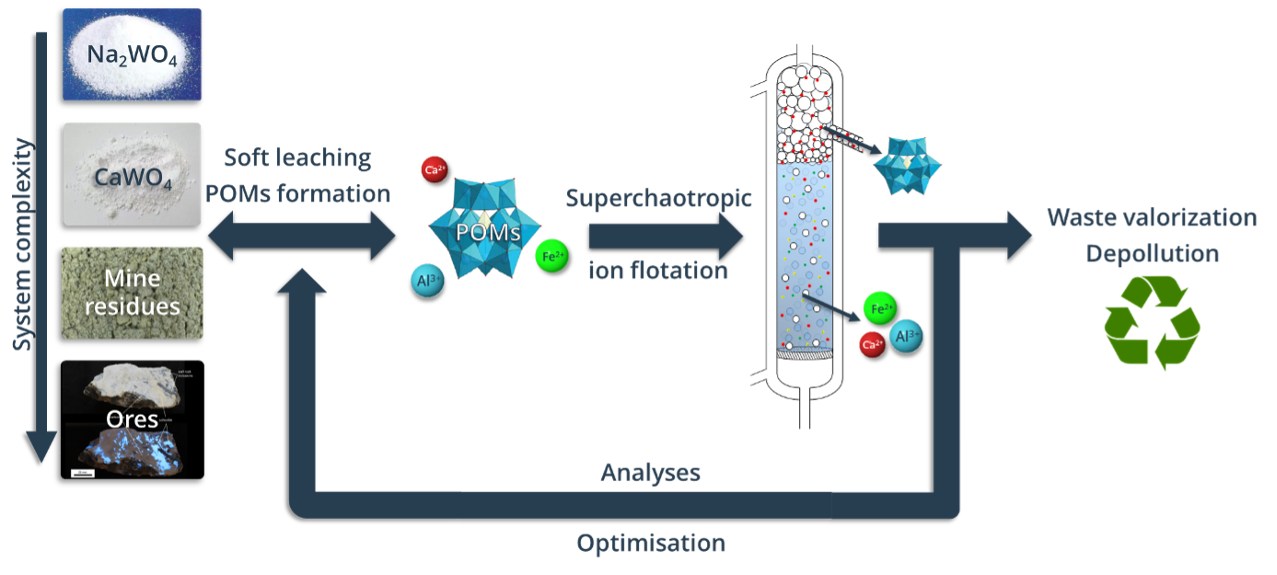
This thesis develops a low-impact approach for recovering tungsten from mine residues containing scheelite, based on the formation of superchaotropic polyoxometalates and their separation by foams. under soft acidic leaching conditions by H2SO4-H3PO4 controls the speciation toward the Keggin-type phosphotungstate H3PW12O40 (HPW), confirmed by UV-Vis and 31P NMR, and quantified by SAXS which highlights molecular species in solution. An optimal acidity window favors HPW while limiting the concurrent precipitation of H2WO4 and CaSO4. Superchaotropic flotation using non-ionic surfactants, notably C8G1, takes advantage of the strong adsorption of POMs on neutral micelles at the air/water interface and enables the selective extraction of tungsten, with demonstrated selectivity over Ca2+. In real matrices, the presence of Fe3+ is critical since it leads to Fe(III)-POM species detected by UV-Vis and impairs foam stability. Conditioning of the medium through selective iron precipitation with ferrocyanide restores foam stability and extraction efficiency without depleting HPW in solution. Application to Salau residues demonstrates the feasibility of an integrated sequence combining mild leaching, targeted iron removal and interfacial foam separation, opening an operational perspective for tungsten recovery.
Credit: ICSM/L2IA
Keywords: Scheelite; Lixiviation; Separation; Foam; Polyoxometalates; SAXS