from the LMCT team and on the following topic:
"Study of UO2 dissolution using ab initio molecular dynamics simulations"
Defense scheduled for Tuesday, November 10, 2026 at 8:30 AM (Auditorium ICSM).
The dissolution of uranium dioxide (UO2) in nitric acid is a key step in spent nuclear fuel reprocessing, yet the elementary mechanisms initiating this process remain poorly understood at the atomic scale. This thesis provides a unified description of these early stages, primarily based on ab initio molecular dynamics simulations within the framework of density functional theory (DFT). The characterization of hydrated actinide dioxide interfaces first establishes the roles of hydration and protonation in their reactivity. The study of nitric acid dissolution then reveals two coexisting pathways: a general acid-base pathway, common to metal oxides, and a UO2 -specific redox pathway, in which uranium oxidation is coupled to acid reduction through interfacial electron transfer enabled by the partially occupied uranium 5f states. The simulations show that NO2• can accept an electron from UO2 to form NO2- and U(V), while extraction leads to a solvated uranyl(V) species. Combined with the equilibria between NO2-, HNO2 and NOx species, these results support a self-accelerating dissolution mechanism in which NO2• constitutes the active catalytic species sustaining the propagation process. They thus establish an atomistic link between interfacial electron transfer and the experimentally observed catalytic behavior.
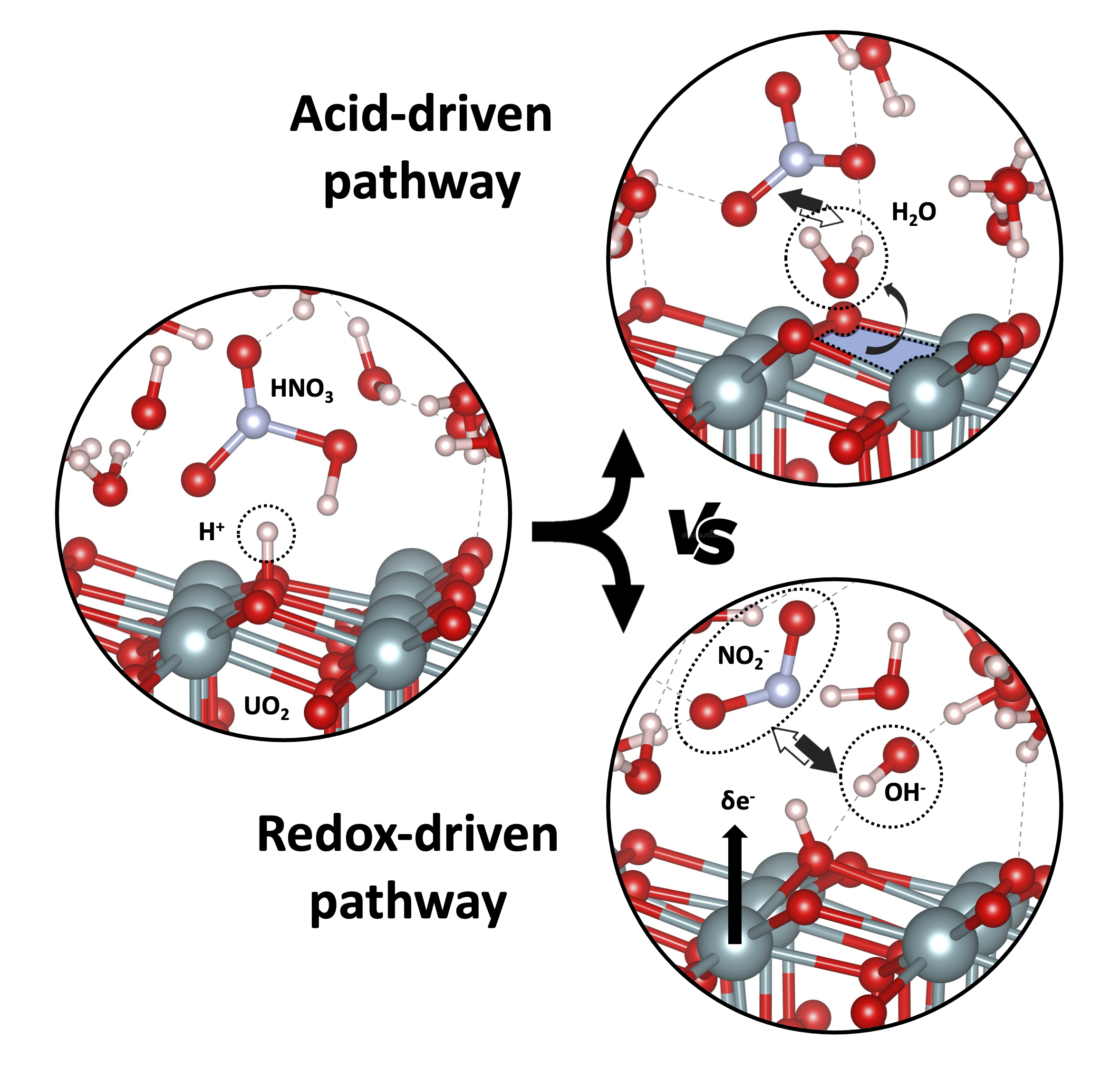
Credit: G. Rodrik / ICSM
Keywords: Dissolution; Uranium dioxide (UO2); ab initio Molecular Dynamics (AIMD); Density Functional Theory (DFT); VASP