from the LMCT team and on the following topic:
"Simulation of Synergistic Phenomena in Ionic Solutions for Uranium Extraction Processes"
Defense scheduled for Thursday, October 22, 2026 at 9:00 AM (Auditorium ICSM).
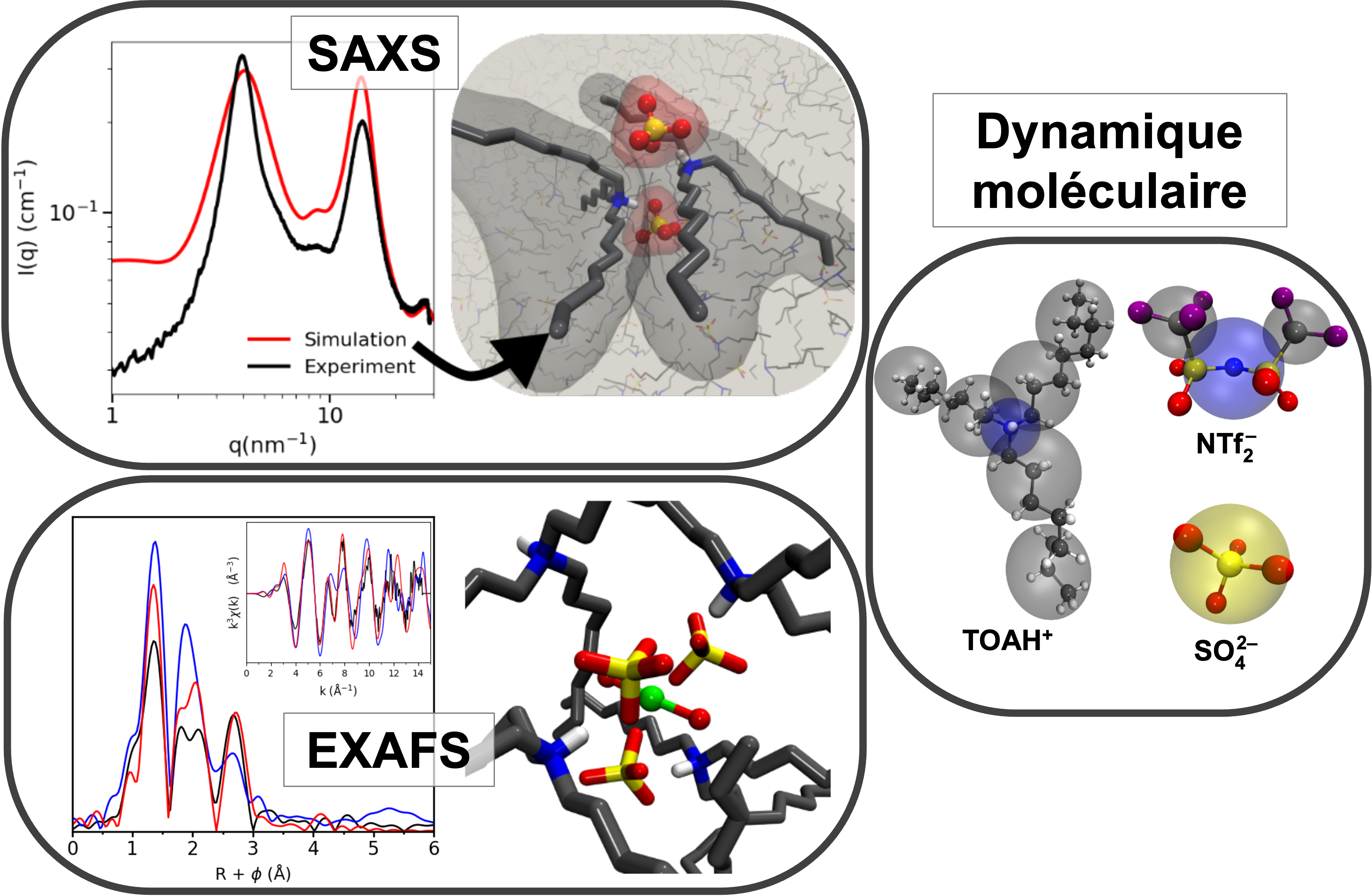
This thesis aims to elucidate the mechanisms governing uranyl extraction by ionic liquid mixtures (TOAH+, NTf2− + (TOAH+)2, SO42−), by establishing relationships between their structure, extraction properties, viscosity, and selectivity towards iron. An approach combining all-atom molecular dynamics simulations and coarse-grained modeling was developed and compared with experimental data, mainly obtained from SAXS and EXAFS. Before contact with the leachate, the simulations accurately reproduce the mixture structure and reveal an original anionic cage organization, where anions remain separated by the alkyl chains of the TOAH+ cations. After extraction, the simulations show that the most stable uranyl species is a dehydrated bidentate trisulfatecomplex, in agreement with EXAFS observations, and allow proposing a mechanism explaining the nonlinear dependence of extraction on ionic liquid composition, based on hydration and anion organization. A coarse-grained model was also developed to investigate the dynamic properties of these mixtures. Although it accurately reproduces their structure, it does not quantitatively reproduce their viscosity. The simulations nevertheless reveal the key role of the hydrogen-bonding network in its nonlinear increase with SO42− content, with SO42− anions forming stronger and more numerous interactions than NTf2− anions. Finally, a chemical-potential-based approach qualitatively reproduces the evolution of uranyl selectivity towards iron, while highlighting the current limitations of classical simulations for quantitative prediction.
Credit: ICSM / J. Klein
Keywords: Molecular Dynamics; Coarse-Grained Molecular Dynamics; Biased Molecular Dynamics; Liquid-Liquid Extraction; Structural Properties; Free Energies of Transfer