from the LMCT team and on the following topic:
"Stability of organic colloidal dispersions predicted by multi-scale modeling"
Defense scheduled for Tuesday, October 6, 2026 at 9:00 AM (Auditorium ICSM).
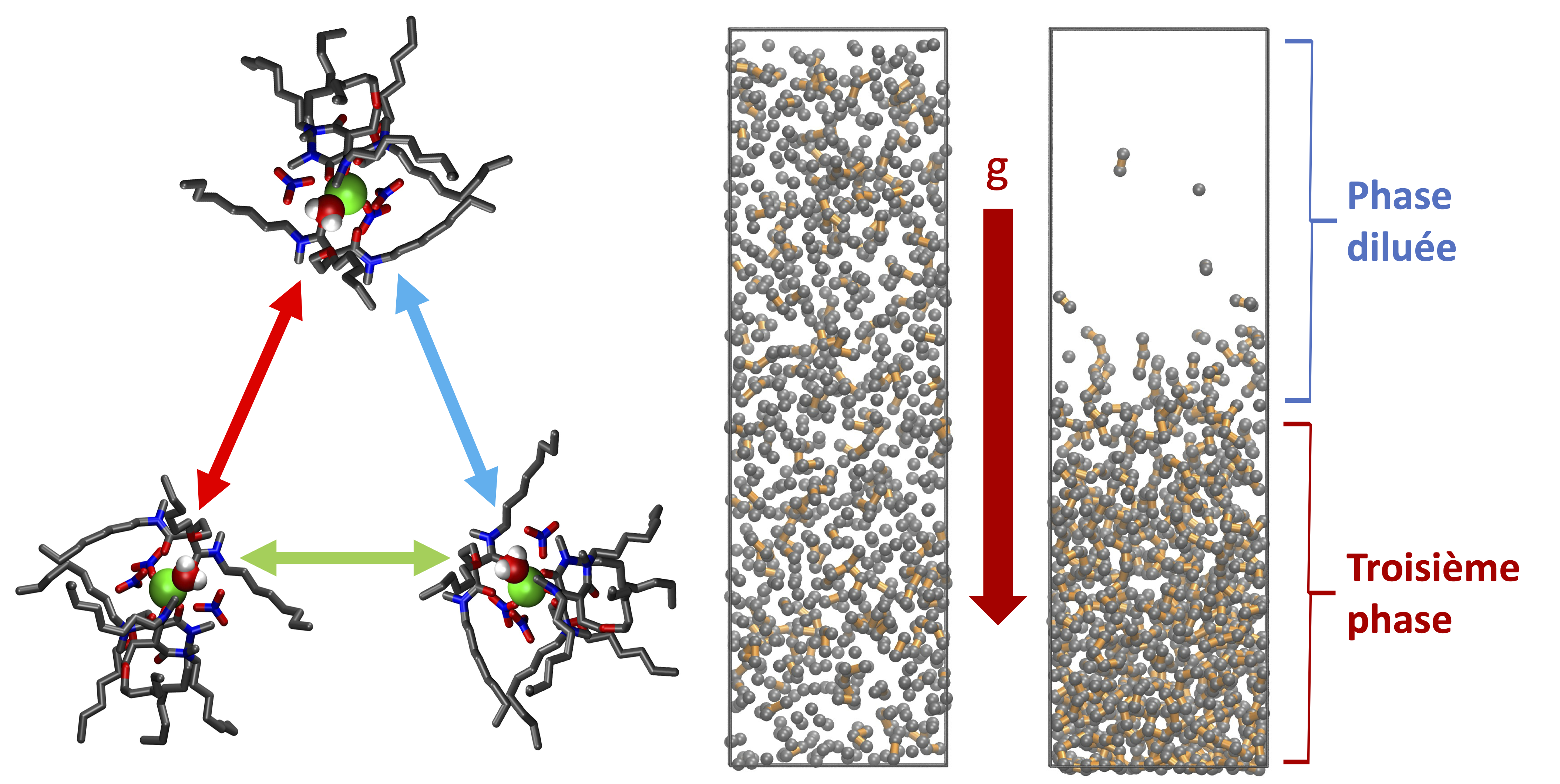
This thesis investigates the mechanisms responsible for third-phase formation during the liquid-liquid extraction of lanthanides. Its main objective is to link the molecular structure of reverse micelles to their collective behavior and determine whether this phase separation can be described as a liquid-gas transition, through the development of theoretical chemistry modeling approaches combining classical molecular dynamics simulations and coarse-grained models. Molecular dynamics simulations reveal that the aggregates are more dynamic and disordered than commonly assumed, with significant solvent penetration into the apolar corona. Biased umbrella sampling simulations further highlight the key role of water molecules in aggregate fusion and identify van der Waals forces as the main attractive interaction. Based on these results, a coarse-grained model was developed in which each aggregate is represented by a single particle. While pairwise interactions alone reproduce a liquid-gas transition, they fail to describe the experimental thermodynamics. The explicit inclusion of three-body interactions, derived from atomistic simulations, improves the model and enables the quantitative reproduction of experimental coexistence concentrations. This work demonstrates that third-phase formation can be interpreted as a liquid-gas transition driven by aggregate interactions, but that its accurate description requires the inclusion of collective and many-body effects. More generally, it provides a multiscale framework for modeling liquid-liquid extraction systems and developing predictive tools for metal separation processes.
Credit: ICSM/G. SZCZEPAN
Keywords: Molecular Dynamics; Biased Molecular Dynamics; Coarse-grained simulations; Liquid-liquid extraction; Reverse micelles