
from the LSFC team and on the following topic:
"Depollution of sandy-loam soil by washing assisted with ultrasound"
Defense scheduled for Wednesday, July 8, 2026 at 1:00 PM (Auditorium ICSM).
With the expansion of anthropogenic and industrial activities, heavy metal contamination in soils has increased markedly, becoming a major environmental concern. To address this issue, various remediation methods, including physical, chemical, and biological approaches, are commonly applied. Among these techniques, leaching is widely used due to its efficiency and relatively short treatment duration. The work presented in this thesis is based on a combined approach coupling leaching with ultrasonic assistance. Two ultrasonic frequencies were investigated: a low frequency of 45 kHz and a high frequency of 358 kHz. Ultrasound application modifies the decontamination kinetics, which are characterized by an initial rapid stage followed by a diffusion-controlled regime. An increase in the apparent diffusion coefficient was observed, particularly at 358 kHz, indicating enhanced mass transfer. At low frequencies, reabsorption phenomena— possibly associated with particle fragmentation—may limit the improvement in extraction efficiency compared to silent mode. Overall, these results highlight the combined influence of soil properties, washing agent characteristics, and operating conditions on the mechanisms controlling decontamination. The main objective of this thesis was to assess, using real soils contaminated with Cu, Ni, or Zn, whether the decontamination behavior observed in a model matrix can be extrapolated to more complex systems representative of natural conditions. The results showed that decontamination does not occur uniformly in bulk soil and its particle-size fractions, revealing distinct behaviors. The influence of contaminant type, Bordeaux mixture versus CuSO4, as well as the effect of contamination aging, was also examined.
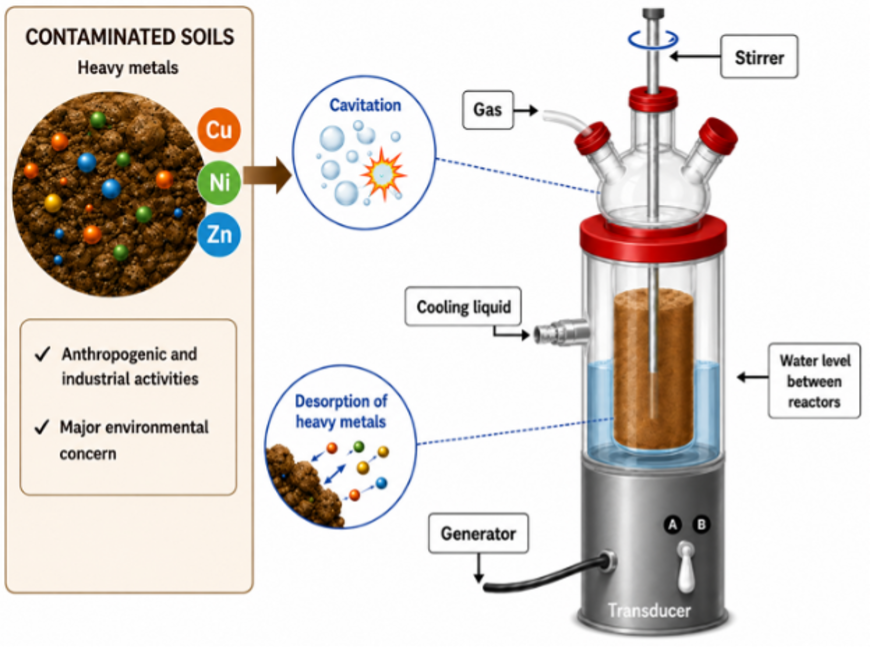
Credit: ICSM / SALAMEH
Keywords: Remediation; soil; heavy metals; ultrasound; leaching