
from the LNAR team and on the following topic:
"Development of selective solar-absorbing coatings using electrophoretic deposition"
Defense scheduled for Tuesday, June 23, 2026 at 9:00 AM (Amphi Godechot – ENSCM).
As reducing fossil-fuel consumption becomes increasingly necessary, the development of efficient solar absorbers for photothermal collectors is an important challenge. This thesis focuses on the development of solar-selective coatings deposited by electrophoretic deposition onto infrared-reflective PtSi substrates, using carbon nanotubes and Fe3O4 nanoparticles as absorber materials.
First, the stability of the colloidal suspensions was assessed prior to deposition by using zeta-potential measurements coupled with dynamic light scattering, while coatings were analyzed by SEM, EDX, XRD, and reflectance spectroscopy (from UV up to far infra-red). For CNT coatings, optimizing the dispersion protocol, in particular surfactant concentration and sonication parameters, together with deposition conditions, enabled the formation of homogeneous films at low electric field. Optimal performance was achieved at 4 V·cm-1 for 3 min, resulting in a thickness of about 330 nm, a solar absorptance of 0.91, a thermal emittance of 0.063, and a spectral selectivity of 0.93. Optical simulations based on the transfer matrix method highlighted the key role of film thickness in controlling reflectance and overall optical performance.
For Fe3O4-based coatings, the influence of processing parameters (solvent composition, stabilizer concentration, sonication time, electric field, deposition time, and suspension concentration) on film morphology, thickness, and optical properties was investigated. Homogeneous and reproducible coatings were obtained under optimized conditions, with spectral selectivity values reaching up to 0.88, demonstrating that Fe3O4 is a promising absorber for low- to mid-temperature solar thermal applications. Finally, the influence of Fe3O4 nanoparticle morphology (sphere vs. rods) was examined by comparing both shape and size. At identical thickness, 6 nm nanospheres exhibited better performance than nanorods of similar diameter (selectivity of 0.80 vs. 0.73).
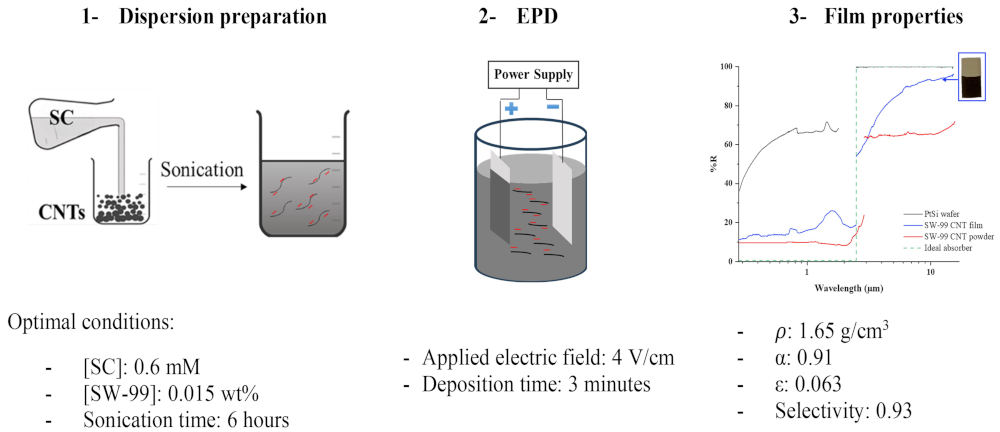
Credit: ICSM/ Al Amouri
Keywords: Electrophoretic deposition; nanoparticles; solar absorbers; carbon nanotube; magnetite; colloidal stability