from the LNAR team and on the following topic:
"Mesoporous silica as model materials for nuclear glass alteration gels: Coupled effects of water and radiation on siliceous porous structures"
Defense scheduled for Monday, June 8, 2026 at 2:00 PM (INSTN Room A1.08).
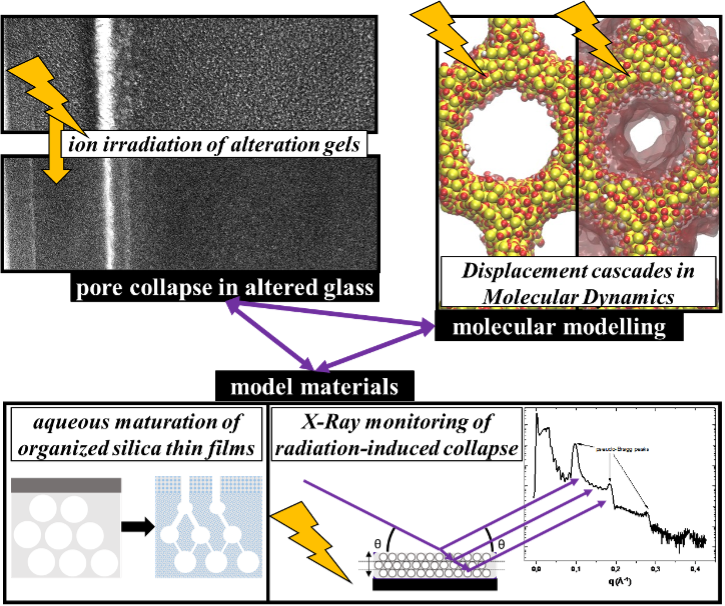
In France, high-level radioactive waste ought to be vitrified for geological disposal. The long-term behavior of this “nuclear glass” has been under study for several decades. Numerous studies on the aqueous corrosion of glass have established the formation of an “alteration gel” with nanometer-scale porosity. However, it has also been demonstrated that irradiating mesoporous silicas, or more recently in TEM, altered glass lamellae, can cause pore collapse. This thesis work examines couplings between these two factors. First, pore collapse was confirmed under external irradiation and in-situ TEM irradiation. Model materials were then proposed.
In laboratory experiments, organized mesoporous silica thin films were altered and irradiated. Their pore collapse behavior was then compared with that of non-altered thin films. Notable observations include a delay in the collapse fluence threshold, and transitory swelling at low fluences. In addition, mesoporous silica powder particles were irradiated in-situ in TEM environment. Depending on the pore size hierarchy, several collapse regimes could exist. In Molecular Dynamics, porous silica cells partially filled with water were simulated. The accumulation of atomic accelerations subjected these systems to displacement cascades. Analysis of the produced configurations evidences that free water presence is a determining factor, causing a radiation-assisted dissolution mechanism that is sufficient to explain major experimental observations.
These results are expected to clarify certain aspects of nuclear glass alteration, provided that the proposed method can be extended to other compositions (aluminosilicates). More fundamentally, the collapse of pores under irradiation is better described, particularly regarding water-silica interactions.
Credit: ICSM/LNAR
Keywords: Irradiation; Porous materials; Alteration gel; Nuclear glass