New results (09/12/2025)
Team L2MEAs part of the ANR Aluplat project, which brings together ICSM and three other national laboratories, an automated control program for an environmental scanning electron microscope has been developed. It enables the automatic acquisition of images at different magnifications and over multiple regions of interest, while adjusting focus (focus and astigmatism) and ensuring accurate centering of the regions of interest, over periods of several days. This system was used to characterize the oxidation of single-crystal nickel-based γ/γ′ superalloys over 120 hours at 920 °C. The localized (both spatially and temporally) formation of NiO whiskers was revealed, and their formation mechanism was explained.
In a completely different field, surface crystallization of a glass was observed over 160 hours, making it possible to highlight complex processes involving the formation of multiple phases. This tool can potentially be used to carry out other long-duration experiments (controlled humidity, mechanical testing, etc.).
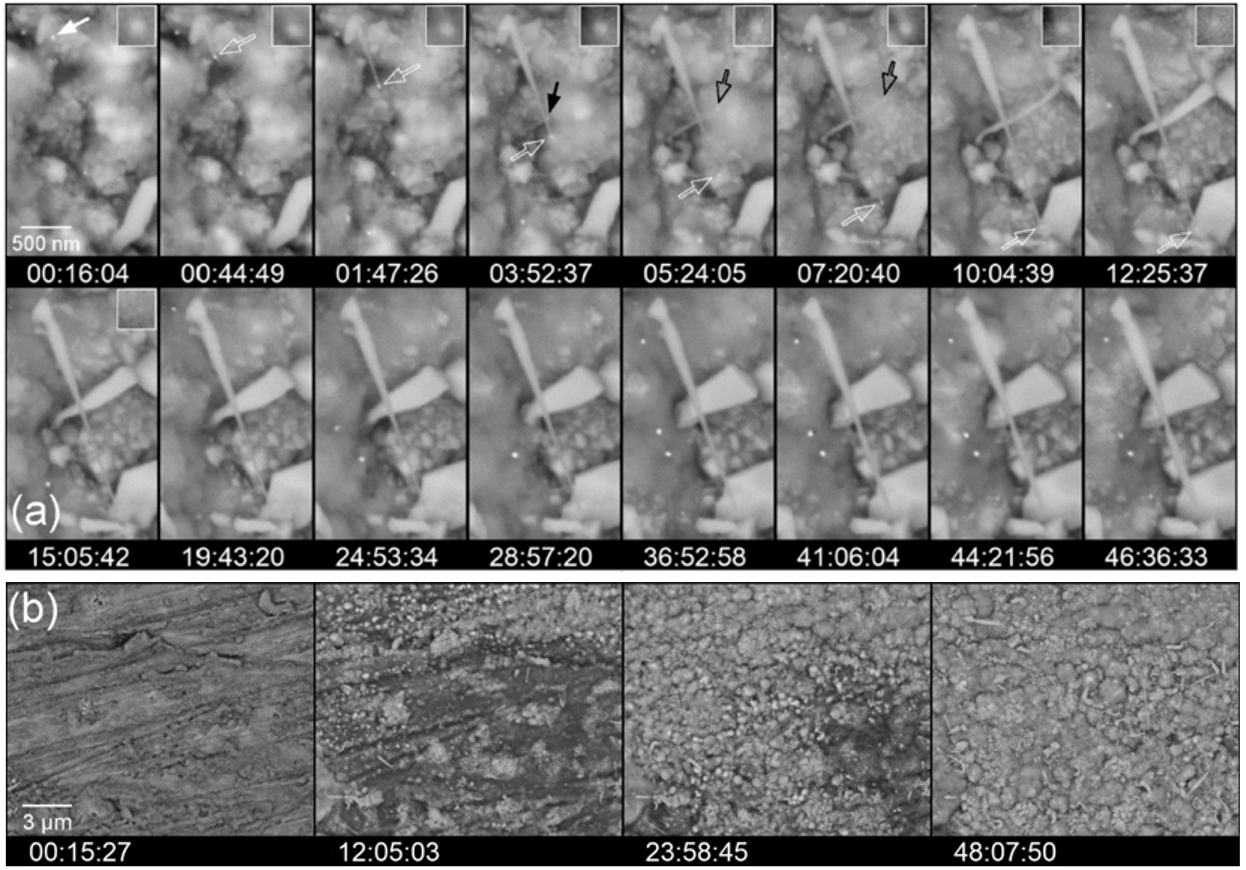
Credit: ICSM/R. Podor
More information can be found in the following articles: