
from the LNAR team and on the following topic:
"Development of captors integrating carbon for ionizing radiation application"
Defense scheduled for Tuesday, December 16, 2025 at 2:00 PM (ICSM Auditorium).
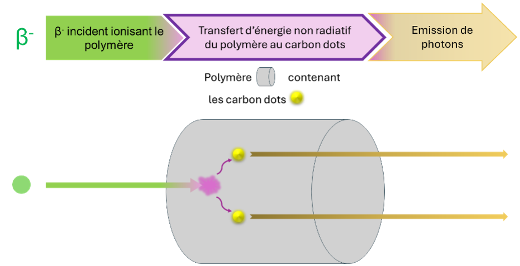
Carbon dots (CDs) are stable carbon-based nanomaterials, soluble in aqueous or organic media and emitting from the visible to the near-infrared range. As such, they are good candidates to replace part or all of the organic fluorophores in plastic scintillators, where the detection of β– radiation relies on the conversion of ultraviolet light into visible light within a polymer matrix. In this context, this thesis aims to clarify the role of CDs in the scintillation of polymer–CD nanocomposites and to identify the mechanism of the emission under ionizing radiation.
After optimizing the synthesis and separation protocol for the first nanomaterials (CDs-GEN1), their luminescence was re-evaluated, showing that the emission observed in the polymer–CDs-GEN1 nanocomposites originates mainly from residual organic fluorophores rather than from CDs. A second generation (CDs-GEN2) was then produced via a solvothermal route and characterized using structural and photophysical techniques in order to confirm the predominance of genuine CDs.
Polymer–CDs-GEN2 nanocomposites were subsequently prepared and subjected to scintillation measurements under β? irradiation. The results this time clearly show luminescence carried by the CDs and make it possible to propose a mechanistic scheme for energy transfer and scintillation conversion in these materials. This work thus paves the way for the design of plastic scintillators incorporating carbon dots and provides insights for optimizing nanocomposite structure for radiation detection applications.
Credit: ICSM/LNAR
Keywords: Photoluminescence; Carbon dots; Plastic scintillators; Energy transfer; Ionizing radiation